Saturday, October 15, 2016

On This Day...Sharing Birth Stories

Fourteen years ago today I was precisely 40 weeks pregnant with our second child. Yep, it was my estimated due date. It was also the day after we had new sod go in our newly landscaped backyard. Frustrating the avid gardener in me, the landscapers did not "tamp down" the new grass, helping the roots to connect with the soil below. 

This was not acceptable and off we went to the equipment rental company...my mom, my full belly, and I. There, I rented a metal roller, the kind you fill with water and then roll it across the grass to help tamp it down and smooth out any unnecessary pockets. The men at the rental store asked if there was someone at home who would be doing this for me. To which I answered, "No, I plan to do it myself." Aghast, he asked when I was due. With cheer in my voice, I said, "Today."

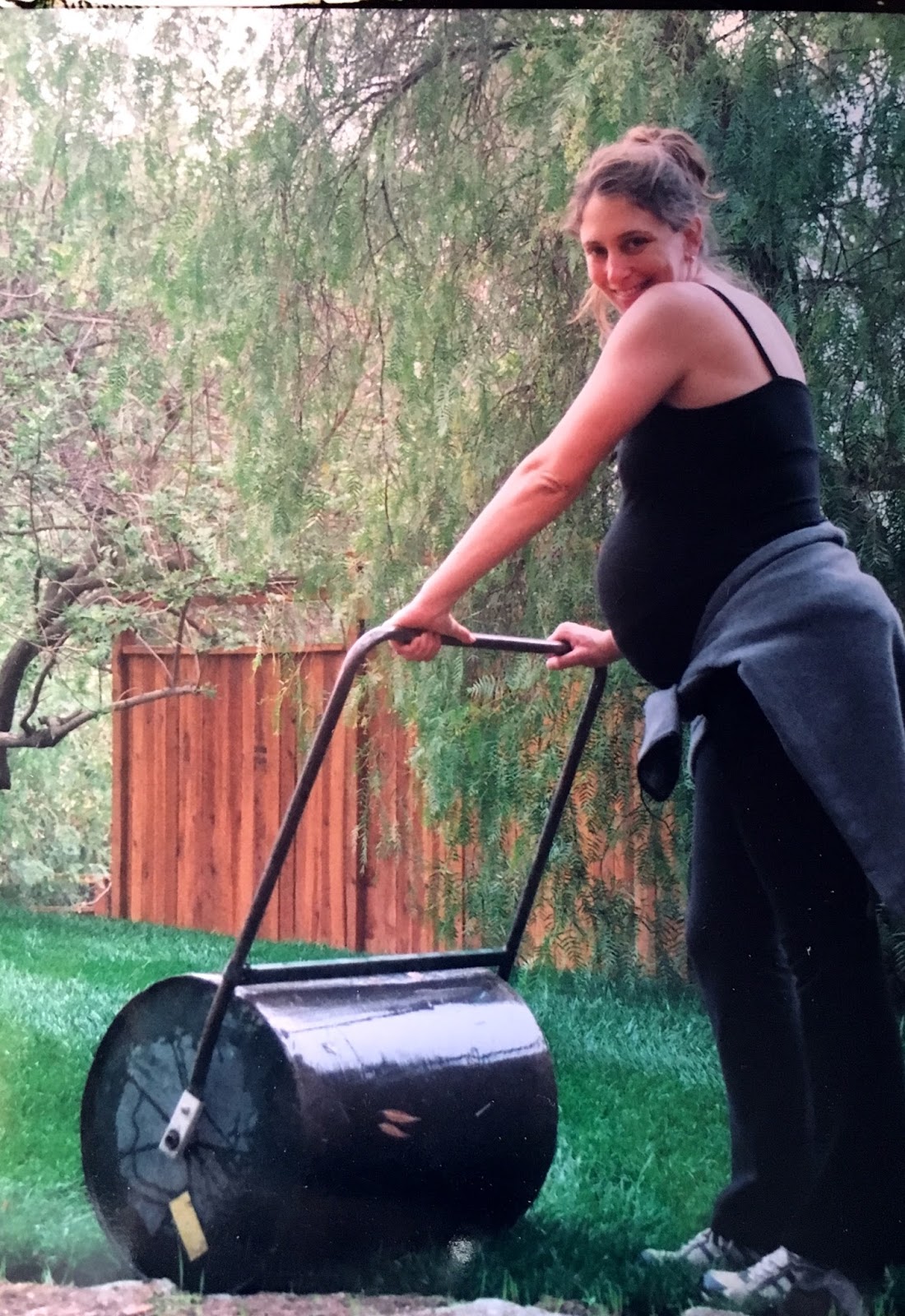
Somehow that day, I did manage to get the 250+ lb roller out of my minivan and roll the grass! Thankfully, I have photographs to prove it as I can hardly believe it myself. That night, I sat exhausted in my favorite chair after putting our toddler to bed and proudly proclaimed my gratitude that I had not gone into labor. I was beat!

It's sort of funny how those things go, large proclamation to the Universe and then...yep! Our son was born just after midnight that evening.

But this is where sharing my birth story (in this manner at least) ends. What happened between that proclamation of exhaustion and our baby's arrival just after midnight is sacred, special, and remarkably, transformatively, intimate. How might I communicate just what happened that night and all that occurred inside my soul during those hours? To do so would be to invite you into a part of my being I share with only a few of my most beloveds. Birth, to me, is a lot like your most transformative and intimate sexual experiences. Not that birth is sexual itself (although it can be). Rather, I mean this is in terms of who I let in, with whom I share these moments, their profound sacredness and in how inconceivably difficult they are to translate in ways that allow others to enter the moment with me.

And so for me I share the story of tamping the grass, I share the story of our older son meeting our new baby for the first time, I share the humor of his being born just a few minutes "late," but what occurred within those bookends, those moments are for me, my family, and our intimate circle with whom we carefully and selectively choose to share them.

Few hold the strict stance on sharing their birth stories that I have, nor do they need to. 


Each birthing person gets to decide for themselves how they share or don't share their unique story. 
It is, after all, theirs to do with as they please!

I have found that new parents who share their stories in thoughtfully selected, supportive and even therapeutic environments, often find that the act of telling their story supports them on the path of healing and integration. Therapeutic and healing story-sharing is most effective when there is little to no concern for how the story will be received. In other words, helpful birth story sharing thrives where the values of acceptance, non-judgment, and empathy are foundational. 

As a birth professional,  I apply a "do not share" standard to how I hold the stories of births I attend. I may reveal a snippet of a birth story in my teaching or writing, always with a specific learning objective and without any names or features that could be identifiable. I have my intimate group of trusted colleagues where I can go to process my experience, what happened, what I did and didn't do, where I felt strong or powerless, where I wish I'd done things differently, what I can learn and grow, and where I shone brightly in my personal genius (that we each have). Birth is powerful. We all need sacred circles within which we can be witnessed, but that is far different from processing publicly on social media.

I am on call to doula for a birth as I type this. This mother's estimated due date was yesterday. It is no wonder that I reflect upon my own labor 14 years ago as I await the call that could come at any moment. The phone will ring and I will drop everything to support a couple as they step across the threshold that will transform them from couple to family. 

If I am fortunate enough to be there to share in this experience, I will hold it as a profound gift, a shared intimacy, a few moments of magic woven together in a unique and privately shared rite of passage.  As such, the story of their birth will be theirs alone to share if, when, and how they desire. 


Saturday, October 8, 2016

The Myth of Self-Care

I often hear new parents, especially new mothers, talk about the importance of self-care. Birth professionals also drive home the need for new mothers to take care of themselves. And while I agree it is important to take care of oneself even while caring for a child, we can also use it against ourselves as one more way we aren't measuring up.

When our first child was born, my husband and I lived in a studio guest house.  We cooked, ate, slept, worked and socialized all in the same one room. For the first several days after Kaden was born even my mom shared that living space with us. Privacy wasn’t just a privilege; it was an unattainable illusion! Even though that baby is now driving, I remember those early days well. Each day was a process of going from diaper change to feeding and back again. In some ways, that one room made things simpler if not easier. The world my little family and I created was contained within one set of walls. The act of going from bed to kitchen involved not much more than a roll out of bed followed by a few steps or stumbles.

Not long after Kaden was born, we moved into our home. Suddenly, we had closing doors, the possibility of privacy, our baby had a room of his own, and we finally had a closet! And while the space brought breathing room for all of us, it also added to my list of things to “get done.” When wrapped in the womb of that small one room studio, we stumbled around those precious and difficult postpartum days. Nothing beyond caring for our new amazing family member held much importance. The rub really started after we moved, after our baby was less freshly born, and after I had a sense that I “got this.”

It was at that point where I began believing I could get shit done—dishes, the laundry, the toilets, the yard, the garbage, the in-laws, and my work. The to-do list grew along with my competence, keeping relaxation forever slightly out of reach. Around this time, I began hearing the mantra of self-care. Now, in addition to everything else on my to-do list, I also had to make sure I "took care of myself." 

A new mother is often already giving every ounce of her life force to care for her infant. New parenting alone takes a LOT out of us. Add to that the idea that a parent has to take a bath, or get to the gym, or "take some time for herself" and intensity only goes up. Instead of helping a mother actually tend to herself, the rally cry for self-care can make mothers weary, increasing the list of things they can't seem to get done!

Many of us want to adopt new self-care practices and rituals--meditation, yoga, journaling--and when we don't keep it going, or find that the job of parenting always seems to get in the way, we collapse upon our own best intentions. A teacher of mine once said to me, "We cannot force ourselves into a new spiritual or self-care practice. We must be called to it from joy rather than obligation." 

What calls to you from joy? What calls you to tend to it, not because you should, but because the whispering voice in your belly yearns to be heard? Follow that longing with small movements toward it. Move not as another thing to check off your to-do list, rather as a momentary gift to your soul. It may be as simple as a few present moments in the shower while you feel the warm water roll down your skin and the aroma of a favorite soap fills your senses.

Self-care can be made up of small moments rather than grand gestures. Think of self-care as a moment of remembering to be in your own body. Notice what you are feeling, breathe a deeper breath, and inhale a smell you enjoy--one that reminds you that being human isn’t all about baby poop and spit-up. 

Self-care doesn’t necessarily require a babysitter or even time alone. It can simply be opening yourself to your own bodily experience and turning toward a moment of enjoyment.

Self-care as a practice, is the act of remembering to turn toward yourself in any moment. Post-it notes are a favorite tool in this regard. What one word will help you remember to practice self-care? I put my Post-it notes on my bathroom mirror, refrigerator, above my desk, and on the dashboard of my car.


I invite you to make a ritual of turning toward yourself as a regular practice beyond the to-do list activities of self-care adorning social media. This form of self-care can even be practiced while living in a single room studio with your newborn, husband, and mother. 

Candles are not required.

Monday, June 6, 2016

Things Don't Always Go as Planned


For the last three months I have been eagerly awaiting June 4th, the day I would get to welcome a group of birth worker sisters to my workshop space and home for a sisterhood retreat and sleepover. Together and individually we prepared for our time together: gathered necessary items, planned our time, prepared the space, bought and prepared nourishing and less nourishing food items to help us get through and celebrate this time together, made plans with our families for our time away from them, and journeyed from our homes to the location where this much anticipated event would occur. We gathered together in Topanga Canyon on Saturday morning with smiles and excited anticipation of our time together.

Everything was in place, just as we expected. Well, almost.

We got a note a week or so before our event from one of our sisters letting us know that she could no longer join us due to a health issue. Then another emailed the night before that she too could not join us as it just wouldn't work with her new family and another mama couldn't swing it along with a recent move and recovery from having sick kids. The morning of our special weekend, another mama emailed she just couldn't do it with everything else happening in her life. From 13, we were down to 9.

The 9 of us there, gathered, joined together, dropped in, and readied ourselves for our much anticipated retreat. Collectively, we created an altar and shared our intentions, moved our bodies, grounded on the land, and embraced the energy of sisterhood. This was going to be just as we intended! AMAZING!

Our collectively created schedule of events included movement, rebozo work, discussion/exploration of archetypes, fire circle ritual and singing, belly binding, and an overview of my dissertation (per request of the group). These were our scheduled modules. We also had many open times for swimming, talking, eating and the chance to share a glass of wine together in person rather than via social media, the thought of which inspired the weekend to begin with! You might say, we had a two page, carefully constructed, birth plan for our weekend.

And, as is often the case, the Universe had other plans.

At about 4:30 on Saturday, in the midst of our discussion about archetypes, my neighbor burst into our space with the announcement that there was a fire.

Did I mention we were in Topanga?

We stepped outside the bubble of our workshop womb to see a large billow of smoke rising across the ridge in front of us. Living in a dry chaparral environment known for its flammability, fire is both familiar and terrifying.

And did I mention we were a group of BIRTH workers gathered together for this event...women both skilled and experienced in managing high stress situations with unpredictable outcomes?

Yeah. That's who walked out and faced this unwished for addition to our highly anticipated birth...I mean retreat.

The next hour was spent educating ourselves on the severity of this unwished for situation. What do we know? Where is it? What are the current concerns? What if we wait an hour? Are there other things we could try first? How are we feeling about this situation? What does my/our intuition say to do or not do?


Knowing what I know about fire, Topanga, and emergency services and access to information in times such as these, I tag-teamed my phone and computer, put on the TV and gathered my neighbors who had lost internet access when the fire began (they have a different service provider than I do). We set up command central in my living room and waited.

The birth workers also waited, as they are so good at doing. They went on with the afternoon knowing at any moment the next best thing to do might be to pack up and leave, but for now, we did not need to pull the plug entirely, rather simply adjust. Like in birth, time would give us more information and more experience with which to guide our next move.

Like we often have to do in labor, I gave myself a comfortable boundary within which to relax and wait: if any area in Topanga was put on mandatory evacuation orders or my area was given voluntary evacuation orders, we would call the retreat complete. No one wanted to. We had done so MUCH to get HERE to this moment. Our dreams and expectations were grand! In none of them did a major fire event enter the fantasy.


Time passed. The retreat group swam in the pool and enjoyed each other's company, with their stuff packed in case it became time to go. I stayed active in my living room command center. The moment came. A few fire zones near mine were ordered to evacuate.

I pulled the plug.

It was no longer time to wait or to look for alternatives. The time had come for greater action. As the sun began to set, we closed our retreat, not with the ceremony planned for the next day, but with a certain amount of haste and motion. We gathered for a group photo on the deck overlooking the smoke plume and said goodbye.

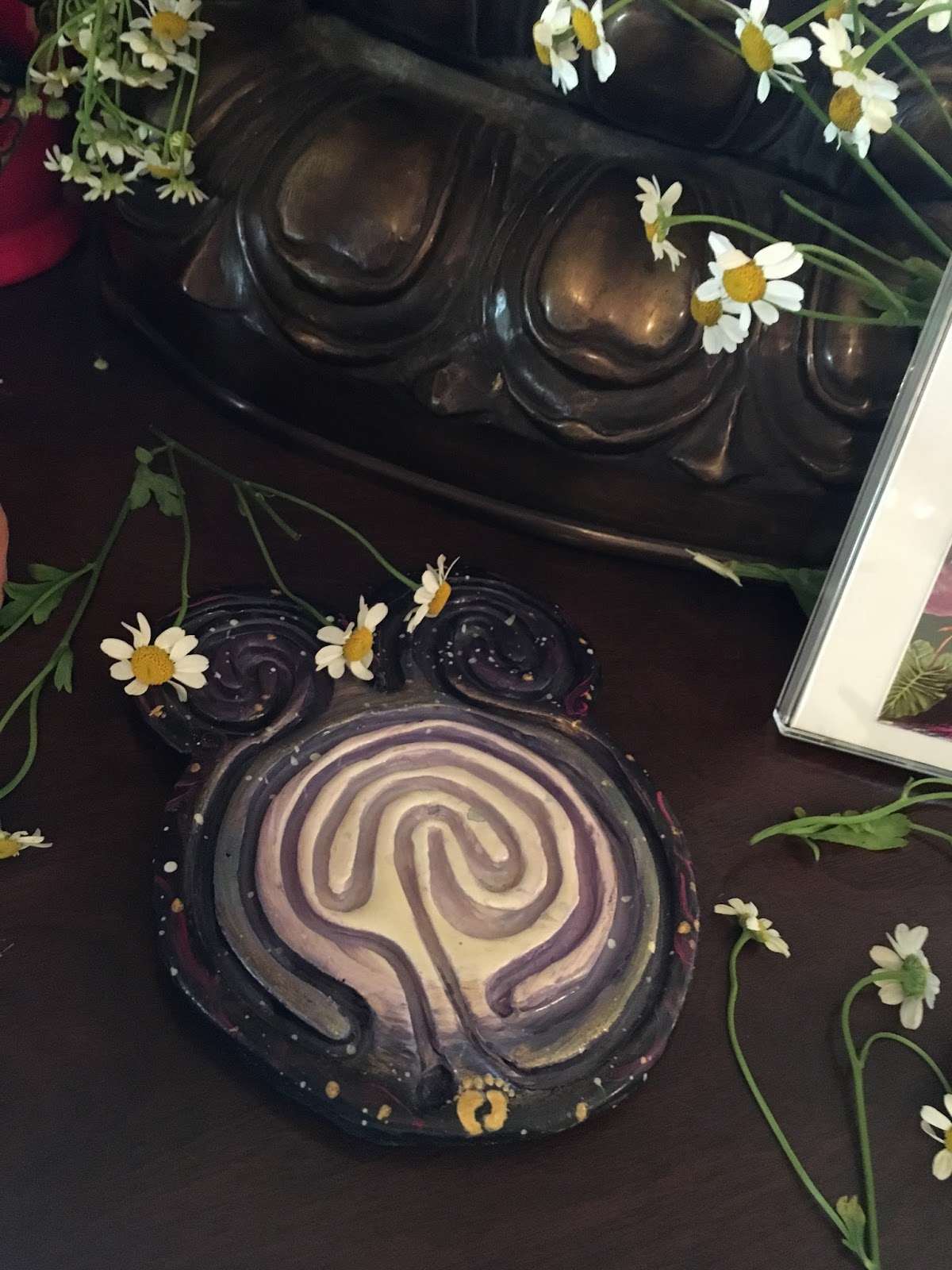
We had to walk our talk. We had to practice doing the next best thing. We had to walk our labyrinth of excitement turned disappointment not as a metaphor, but as real life. Yes, it was "just" a retreat, but the excitement and disappointment was no less real. We got to practice holding both emotions tenderly within our hands and hearts.

The doulas left and my shit got very very real. The letting go intensified as I went around my home looking for things I couldn't live without...treasures, photos, heirlooms and what I could leave to potentially burn...what to hold onto and what to release, even reluctantly.

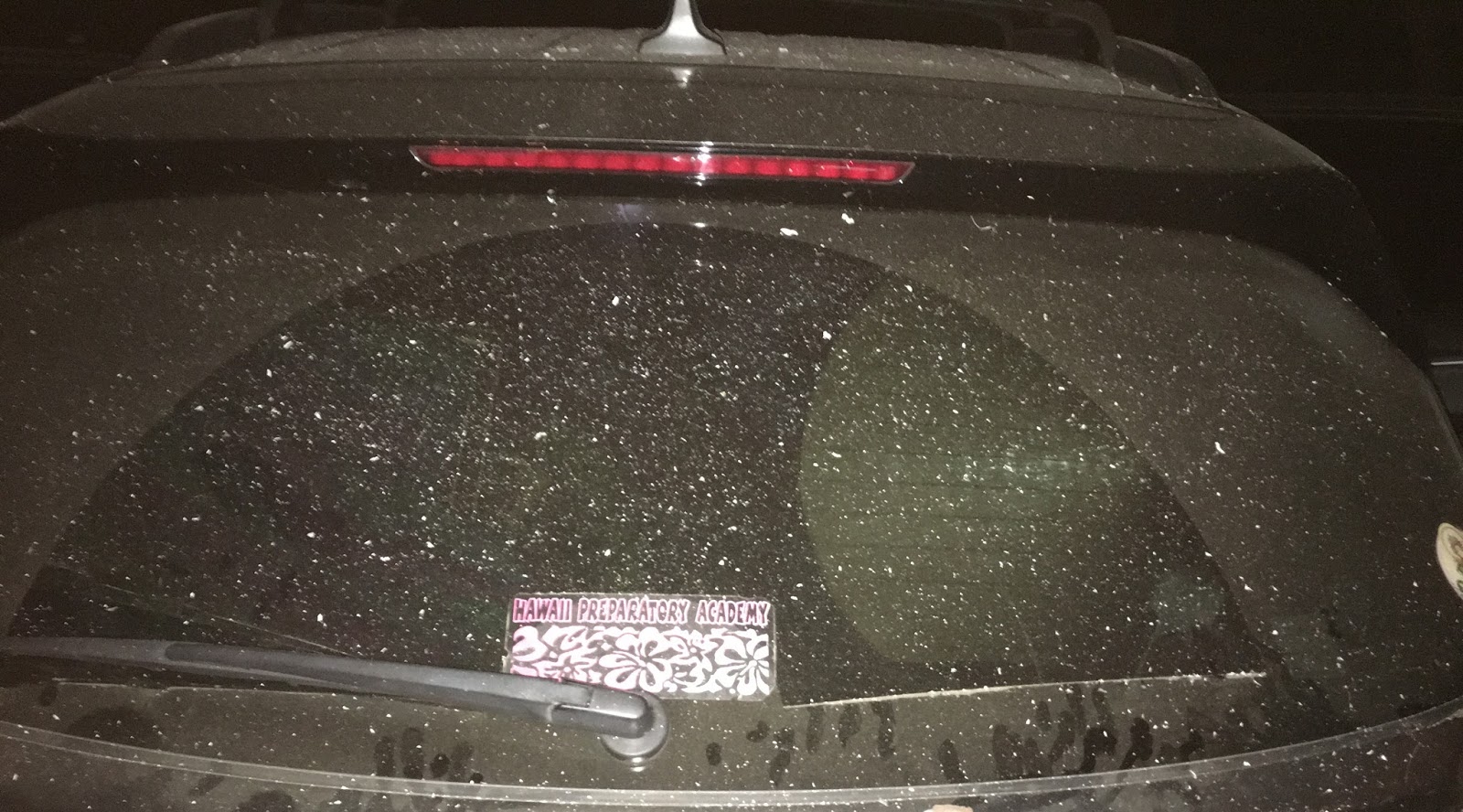
Ash from the fire on the back windshield of my car. 
I had to help my teenage sons do the same. Boys who have lived in the same place their entire lives, young men who have gathered treasures and crap that now fills their shelves and some of which touches their hearts deeply. They too had to decided what to take and what to leave with the possibility, albeit unlikely but felt no less real, of never seeing any of it again.
My husband came home and we loaded our cars with boxes of photos we've been meaning to digitize for the last several years and other important items. Left behind were some surprises: my doll collection from my childhood, my box of high school mementos, my wedding dress. It was an exercise in forced clarity.

As we drove away after our Topanga zone was put on "voluntary evacuation" orders (a decision we made to role model being conservative in terms of safety and to support our emergency responders in making a tough situation as easy as possible for them). We had everything that mattered...our pets, our photos, a few special treasures, some heirlooms, and each other.

Oh, and at the last minute, my son grabbed a few chocolate bars left by my birth worker sisters intended for our retreat, and now soul food for retreating evacuees.

Things don't always go as expected. We plan, we prepare, we organize, we ready ourselves and others for the big event. AND then, we have to let go, practice being with what is, showing up for the moment, surrendering what needs to be surrendered, doing the next best thing, mourning the loss of what we had held with such excitement, and gathering clarity about what really matters.


Saturday, January 23, 2016

Dissertation Abstract

I finished my dissertation last fall and successfully defended it earning my doctorate in December. I thought it might be nice to include my abstract here for those interested in the topic I spent the last several years researching and writing. Enjoy.


ABSTRACT
Forceps and Candles:
Cultural Myths in American Childbirth

Current birthing practices in the United States focus on the outcome and location of birth: surgical or vaginal, medicated or un-medicated, hospital or home. Little focus is placed on the multivalent experience of body, mind, spirit and psyche. After an unwanted birth by cesarean, well-meaning nurses and friends often say, “Be happy! Your baby is healthy.” Comments like this emphasize outcome, ignoring or sidelining the emotional confusion often present at the birth of a desired baby through an unwanted surgery. Similarly, radical natural birth proponents often see failure to birth at home or without drugs as the fault of the mother, as if what matters most is the fulfillment of the natural birth image. The loss of a dearly-held ideal can traumatize a birthing woman. Focus on outcome ignores the importance of the transformations that go beyond the physical expulsion of a baby from a woman’s body.

Childbirth practices in the U.S. exist within a set of cultural myths including the desire for control, logo-centric thought, reverence for the masculine, denial of death, vilification of pain, veneration of technology, and adherence to innocence. Woven deeply into the tapestry of American values, these cultural myths shape both mainstream and alternative childbirth practices in contemporary society. Cast within this cultural context, childbirth practices in America today fail to successfully initiate women into motherhood.

To look at giving birth through the lenses of myth, initiation, ritual and archetypal psychology is to illuminate childbirth as a meaning-making, life-altering, identity-changing event in the life of a birthing woman, regardless of the path the birth takes. To view birth as an initiatory process is to understand and value the unpredictability and uncontrollability of even the best-laid plans. Fear of this “not-knowing” aspect of birthing is central to the preparation for birth as a rite of passage, rather than the nemesis that both medical and natural birth professionals believe it to be. Birth as an initiatory journey embraces challenges and ordeals along the way as part of the path every birthing woman will travel.

Monday, December 8, 2014

Nurturing Charitable Giving in Kids

When I thought about my kids before they were even born, I had ideas, like most moms-to-be that my kids would be good kids, loving and caring. I knew I wanted them to be warm and be able to feel deeply into the lives of those less fortunate. I wanted my kids to want to be do-ers and givers. My husband and I wanted our kids to be compassionate and charitable.

Like all moms, I had idealized notions of both motherhood and my future children. The dreams were easy; it was the manifestation into reality that proved the tougher challenge. How do you teach children to be giving?

Here is my list of what helps instill charitable habits in our children.

1. Nurture their natural charitable instinct 

Kids start early seeing the suffering of those smaller, weaker, and in need of our help. I remember my not yet one-year-old crushed a pill bug/roly poly with his little fingers in front of his older brother who was maybe just over three-years-old. My older son howled in pain for the roly poly, now reduced to mush. He was nearly traumatized by the ruthless and insensitive behavior of his little brother. His pain and anger led him to become the family roly poly crossing guard and to this day (well into his teens) he points out roly polys that have put themselves in harm's way on the path that leads us from the front door to the car, making sure no one accidentally steps on one while rushing to the car en route to carpool pick up.

This may not seem like it relates to developing charitable behaviors, but I believe that was a seed to the very plant of charity I wished to nurture in my boys. It would have been easy to laugh off his initial concern for the small little hard-shelled bug as nothing more than a little kid's fancy. I chose to see it as an expression of his compassion and compassion was (and is) an emotion I wish to see cultivated. After that afternoon in our veggie garden, I chose to take seriously every roly poly crossing guard action my son made. When he stood on the path pointing out potential victims of my too-large shoes, I stepped carefully and slowly, even when we were late.

2. Let kids give, even when you disagree with their choices

There are many of us who don’t want to give to panhandlers out of principle, choosing instead to donate to local shelters, halfway houses, and other charities designed to help in organized and thoughtful ways. Kids, however, see people on the streets and feel either repulsed or drawn in by their suffering. Young kids often have questions and want to know why that person looks (and maybe smells) like THAT. They craved understanding. When our kids asked these questions they almost always followed it up with a desire to do something to help. Even as little kids they wanted to drop some money into the cup or hat, hoping to make a difference. We not only let them, we encouraged them to do so.

At the main intersection of our hometown, there are almost always people holding signs requesting help. You know the ones: They walk up and down the line of stopped cars at long lights, making you want to look away. Since our kids were really little they have seen people struggling and asking for help in this way. I started carrying granola bars, protein bars, bags of nuts, and other quick power-punching snacks, not just for my hungry cranky kids who in a pinch might need something to tide them over, but so I would always have something to give out at the stoplight when my kids had the desire to do something. I would ask them, “I have some nuts and protein bars here. Do you think we should give them some of those?”  Again, my main purpose was to create the feeling of doing something and nurturing the charitable impulse.

3. Help your kids build a charitable account

From the time our kids were old enough to receive allowance, they received it in three different chunks. My husband is a financial planner and works with people and their relationship to money as a core aspect of his career, he even wrote a book about it. Working with people around their money has taught him a lot about the importance of developing a healthy, responsible relationship to money. 

Here is what we did:

The amount of allowance was determined by our child’s age. At 3 our son got $3 a week, at 5 he got

$5 and so on, now at 14 and 12 they get $14 and $12 respectively. This allowance was divided equally into three different jars; spending, savings, and giving. Our boys were encouraged to spend the money in the Spending Jar on whatever they wanted, savings was not allowed to be touched and earned interest (that’s for a different blog), and giving was to be given away as they wanted.
Our boys’ Giving Jar would be pulled out when they had a "jump rope for heart health" event at school, or given to World Wildlife Federation when my older son wanted to save the polar bears, his favorite animal. From an early age we, as a family, were very involved in one particular charity due to our older son’s health condition. Each year when the Walk would come around, our younger son would get his Giving Jar and want to donate all of it to the Walk, hoping it would help his brother. Our boys have had complete control over how the money in their Giving Jar is allocated and it has been deeply touching to see just how they choose to do so. It has had the added bonus of teaching me more about my boys and what is important to them. 

4. Volunteer

There are not as many organized volunteer opportunities for kids as I wish there were. It took a while for my husband to find a homeless shelter that allowed kids to be involved in helping cook a meal, which we did, but there are lots of other ways, even small ways, to volunteer. Eliminating hunger is an important value for my husband so cooking a meal for the homeless was what led him to find an organized way to put action behind his compassion. We’ve also done a number of walks and while this may not be volunteering exactly, I can say that as a family who has been walking and raising money toward a cure to my son’s disease, when friends show up to our walk, it makes a difference not just to the disease, but to my son who sees all his friends supporting him and his efforts.

Lastly, we make volunteering a part of our annual holiday tradition, spending the morning of Christmas Eve every year giving away hygiene kits, blankets, toys, and warm coats to those living on the streets in downtown Los Angeles. We have been a part of this event since the kids were too young to even go down there as babes in arms. But since the age of five they have been every year and having it a set tradition since before they can remember makes it an unquestioned and highly-anticipated part of our holidays.

5. Be a role model

This one is pretty obvious, but not to be overlooked either. Our kids do what we do, not what we tell them to do. For my husband and me, being charitable both with our money and our time is important. We believe in giving away a significant amount of our income and doing what we can to give to causes we believe in. This isn’t something we’ve done as a show for our kids; it is built into our values. That said, we do let our kids know when we are doing something for others, be it volunteering, going to a fundraiser, or sending a check. As much as possible we live this part of our lives visibly for our kids to see, even for things like supporting the fundraising events for the public elementary school they attended.

6. Include them in your family’s charitable giving

Now that our kids are a bit older, we include them in discussions and decisions about how we allocate the money we give away as a family. My husband uses some very clever ways to help families figure out where they wish to give when there are many different people helping to make those decisions. Just this past weekend we sat down as a family over breakfast to make decisions about our end-of-year-giving.

My husband brought home 400 coins, giving each of us a stack of 100. We brainstormed all the different areas where we would like to make a difference in the world and at home. Each of us had a paper in front of us with several different general categories. We divided up our 100 coins on our individual paper, feeling into how we wanted our ¼ of the family charitable money allocated according to our particular beliefs.

Once we had our personal stacks, we then subdivided the categories into actual charities and put the subdivided categories in the center of the table where each of us got to take the coins from the area of our personal paper, say “Human Rights” and divide those coins into specific charities/areas where we would like our money to go.

In the end the number of coins in each box represented the percentage of the total 400 coins and the percentage that represented of our total charitable amount to give away. For example, if one charity had 50 coins in the square at the end, they would get 1/8th of our total amount to be given away. Each of us had the same power to decide where and to whom we give. Each of us also left out ten coins, keeping 10% of our money for more impulse giving throughout the year.

Does this all work and make a difference? Are our adolescent boys perfect? No, but neither are we as parents or as people. We’re fallible, all of us, but we’re doing the best we can and I do believe our kids are growing into adults who value being charitable...we're not completely there! But we are on our way.

My hope is that as all of us help nurture the charitable spirit in our children the world will be a more loving and compassionate place for everyone. Let me know what works for you and your family. I'm still learning and like all moms, welcome new, good ideas on this path toward raising children into healthy adults.  

Thursday, October 9, 2014

Mentoring works both ways

Last night was class #6. That's the grand finale, filled with lots of great experiences to send the parents off ready for the adventure of childbirth and new parenthood. I've been doing this a long time, almost 13 years now, and you could say that for the most part I can push the play button on many processes and they spew forth, more or less, pretty well.

Of course it is my desire to be the "empty cup" ready to respond to whatever presents itself, to be open to the unexpected, and curious about what each individual brings on that particular evening. I'm certainly not perfect and I can unconsciously slip into rote mode. Rote in a Birthing From Within class is far from boring or dull. The only one who really knows I'm on rote is me. The hardest class to do in a rote manner is the last class as it demands a lot.

Which brings me back to last night. I had a pretty good idea what I'd do for our final class as I have a more or less favorite way to end a series. We had a few things to finish up...we had to get Inanna off the "hook" for one and initiating a group of Birth Warriors is almost a must do for me in class 6. But what turned the whole plan on its head was the entrance of one of the couples WITH their newborn!

They hadn't told any of us that they had given birth since class 5 and walked into class with their beautiful new baby. We were all stunned, floored, excited, and wowed! It was fun, but also posed a difficult challenge in terms of holding the space. If I stayed on rote mode, the excitement of the expectant parents and the joy of the new parents would be like a large wave ready to sweep the beach of all it's magical castles. The potential to spiral down into a recounting of the birth story play by play, was very high. We all wanted to hear it, but I am also not a fan of play by play birth stories.

I want to hear about deeper things, like how they were transformed, what awed them about themselves and each other, what surprised them, how he coped and what he did when he couldn't take away her pain, and what she did when she didn't think she could go on. To me, these questions teach, these explorations mentor, these sharings inspire the wide-eyed parents facing the unknown better than any play by play. I had none of them planned. I had no idea that the first hour of class would be spent simultaneously mentoring brand new parents as they navigate the first days postpartum and making sure that doing so (in the public forum of the final class of a childbirth preparation series) deepened the true preparation of the yet-to-birth parents. You could say, I was on the edge of my backjack the whole time. Rote...that flew out the window.

I LOVE when that happens and it is one of the reasons why I'm still mentoring classes now that my own children are nearly grown and long after my interest in birth has lost its initial glow. Not only does this work stretch and deepen the parents and their readiness for the rite of passage of birth...but this work helps me grow...it takes me to my edges, forces me to be fresh and to continually open. This is work as spiritual practice. It is deeply humbling and challenging. For both I am profoundly grateful. It was a very fun class!